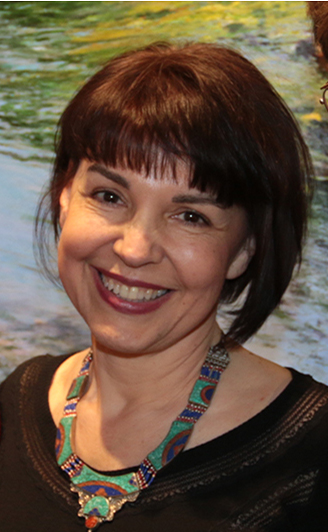
Born in Athens, Greece.
1978-79 and 1984-88, National Superior School of Fine Arts in Athens (ASFA), Greece, Painting, Art History, History of Architecture and Rythmology, Aesthetics, Art Theory and Philosophy of Art, Educational Psychology and Art Education, under D. Mytaras, L. Kanakakis, N. Kessanlis, R. Papaspyrou, Leda Papakonstantinou, V. Kyriaki, Μ. Lambraki-Plaka.
1980 – 1983, Fine Arts School of California State University of Long Beach, (CSULB), USA, Interior Design.
1990-1992, Ecole Nationale Superieure des Beaux-Arts de Paris, (ENSBA), France, under the French Government Scholarship and the Greek State Scholarship, Post Graduate Studies in Painting as “ élève invitée ”, under professor Pierre Carron (Professor at the Ecole des Beaux Arts in Paris in 1967, elected member of the Academy of Fine Arts in 1990 and vice-president in 2018 alongside Patrick de Carolis, President).
Her works can be found in the Greek Parliament, the Greek National Gallery, The Prime Minister Building, The Benaki Museum, The Museum of Modern Art in Florina, The Fryssiras Museum, The Kouvoutsakis Pinacotheque, The Moschandreou Pinacotheque, The Agricultural Bank of Greece Collection, The Piraeus Bank of Greece, The AGET Heraklis Group of Companies Collection, The InterAmerican Collection, and other private museums and collections in Greece and abroad.
Her work was selected to represent Greek contemporary art during the Olympic Games of 2004 in Athens, Greece. On September 2008, as part of the Environmental Programme of the Goulandris Museum of Natural History, she donated one of her works, which was auctioned and bought by the Greek Parliament.
Having developed a very personal stigma in her work, she is considered to be one of the most influential Greek Contemporary artists.
Thematic cycles of her work have been presented in many individual and group exhibitions in Greece and abroad (USA, China, Ireland, England, France, Belgium, Luxembourg, Cyprus, Turkey, Bahrain, Dubai, Lebanon, Korea, Republic of Saint Mauritius).
“You will always ”hover” between representation and abstraction”, she was told in 1992, by Pièrre Carron, her professor at ENSBA, Paris, predicting the future outcome of her work.
“…Chryssa creates images, which sometimes refer to the traditional landscape and other times are more reminiscent of the lunar landscape of Tapies, while, other times they show a connection with the gestural work of Pollock…” (M. Lambraki-Plaka, Professor of the History of Art, Director of the Hellenic National Gallery)